
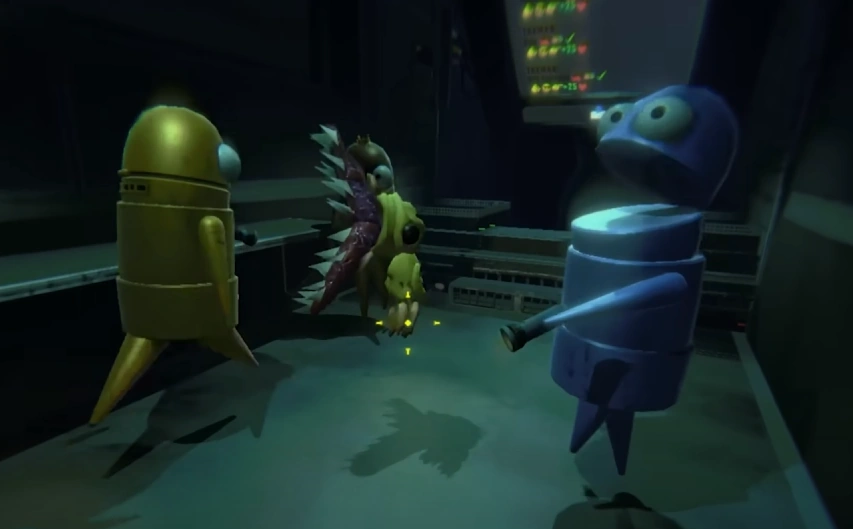
How the game behaves · R.E.P.O. v0.4.0 · read from a local copy
What a monster does when it has not seen you
The roaming state has its own speed and acceleration.
A monster that has lost you in R.E.P.O. does not simply stand still: the game gives it a roaming state with a speed, a path radius, a mind-changing timer and a teleport chance.
What the game establishes
- The roaming state has its own speed and acceleration. (checked against the game's own files)
- Its path has a smallest and a largest radius, with a shortest and a longest time before it changes. (checked against the game's own files)
- It has a roaming cooldown between a minimum and a maximum, and a wait before turning. (checked against the game's own files)
- It can teleport while roaming, with a chance of its own. (checked against the game's own files)
- The build has a part for deciding whether a monster is on screen, with a maximum distance, a margin around the frame and an option to override the camera. (checked against the game's own files)
- It has a time it will spend on screen and a cooldown afterwards. (checked against the game's own files)
- It has timers and distances for a player being near and far, with a value that decreases the near time. (checked against the game's own files)
- There is a maximum number of physical objects it will hit while roaming. (checked against the game's own files)
In play
A monster that has not seen you is still doing something. The game gives it a roaming state of its own, with the details kept on that state rather than on the monster.
It has a speed and an acceleration. Those two values decide how it walks a path and how quickly it gets going, so a roaming monster can be heavy or twitchy without changing what kind of creature it is.
The path is a range rather than a line. There is a smallest and a largest radius for the path, along with a shortest and a longest time before it changes its mind, so the route is decided while it walks rather than being laid out in advance.
It pauses as well. There is a roaming cooldown with a minimum and a maximum, and a wait before it turns, which is why a monster can stand at a corner for a moment rather than pacing without stopping.
It can teleport while roaming. There is a chance of that happening, which is how a creature can disappear from one part of a level and appear in another without having walked there.
It behaves differently depending on whether you can see it. There is a time it will spend on screen and a cooldown after that, so a monster has a rule for how long it is willing to be watched.
Being on screen is worked out for it. The build has a part of its own for deciding whether a monster is in view, with a maximum distance, a margin around the frame and an option to override the camera, which is why that rule can be applied rather than guessed at.
It also reacts to how close you are. There are timers and distances for a player being near and for a player being far, with a value that decreases the near time, which is why the same monster can seem patient at a distance and impatient up close.
There is a limit on how many physical objects it will hit along the way, which is how the game keeps a roaming creature from shouldering the level apart.
What this entry does not tell you: how fast any monster roams, how often it teleports, or how far it can sense a player. We have not verified those numbers, so we do not print them.
Related
 MonstersHow monsters find youThe game tracks which room a player is in.
 MonstersWhat a monster is doingA monster is always in one of a fixed set of named states.
Version and sources
A local copy of the game, read only. The grounding for each fact is listed on the technical reference pages; nothing here is estimated. Documented build: 0.4.0.