
Hazards and events · R.E.P.O. v0.4.0 · read from a local copy
The museum's laser
The laser is a machine of its own with a state dedicated to it.
The laser in R.E.P.O.'s museum level is a machine with a beam of its own: an outer and an inner beam, power-up and shutdown curves, a spinner, a hit position and hit visuals, three kinds of sparks, three audio sources and seven sounds for running, being near, hitting, overloading and shutting down.
What the game establishes
- The laser is a machine of its own with a state dedicated to it. (checked against the game's own files)
- It powers up and shuts down on curves rather than switching instantly. (checked against the game's own files)
- The beam is drawn as an outer and an inner layer. (checked against the game's own files)
- It has a beam visual, a hit visual, an inner hit visual and a hit position. (checked against the game's own files)
- It has a spinner of its own. (checked against the game's own files)
- It carries a hurt collider. (checked against the game's own files)
- It sparks in three ways: an ordinary spark, one for the overloaded state and one for a hit, each with a transform. (checked against the game's own files)
- It has three audio sources: one for the laser, one for being near it and one for a hit. (checked against the game's own files)
- It carries seven sounds: a running loop, a near loop, a hit loop, a power-up, an overload, a shutdown and sparks. (checked against the game's own files)
- The game ships a base colour texture for the security laser. (checked against the game's own files)
In play
Some of what hurts you in a level is built rather than alive. The museum's laser is a machine of its own with a state to run through, which is why it can be reasoned about by the level instead of being scenery that happens to glow.
It comes up and goes down on curves. There is a curve for powering up and another for shutting down, so the laser is never simply on or off but always in one of two transitions.
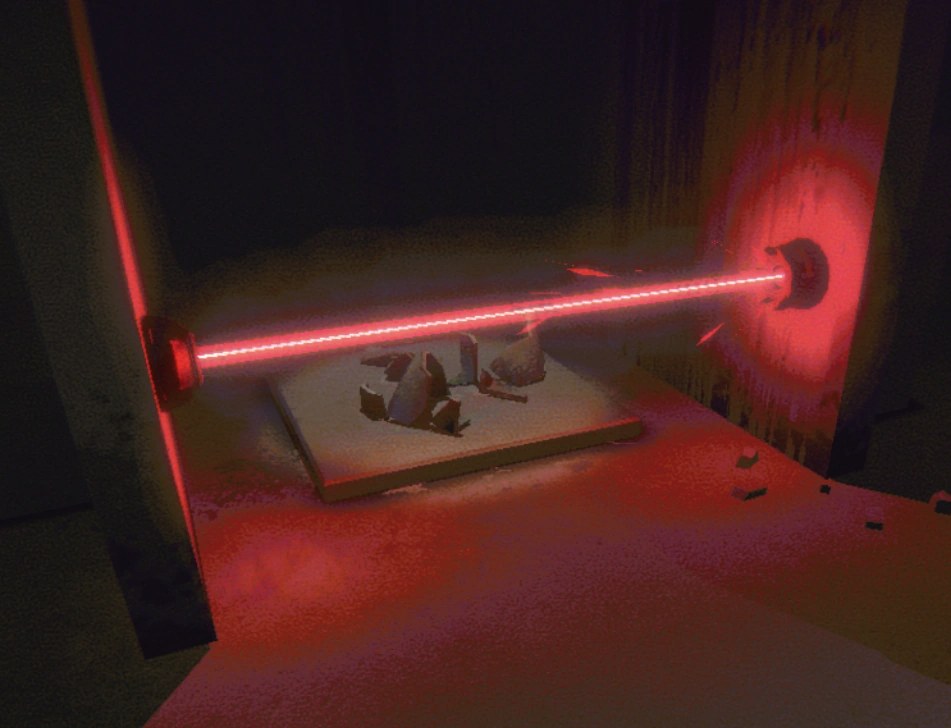
Its beam has two layers. An outer beam and an inner beam are drawn separately, which is why a laser can look like a core inside a glow rather than one flat line.
It has its own visuals for being hit. There is a visual for the beam, a visual for where the beam lands and an inner version of that landing, along with a position for the hit, so the point of contact is a place in the object rather than a spot worked out by the renderer.
It spins. A spinner belongs to it, which is what turns a static beam into something that sweeps across a room.
It carries its own hurt collider, so what the laser damages is a shape that travels with it rather than a rule applied to everything nearby.
It sparks in three ways. There is an ordinary spark, a second set for the overloaded state, and a third for the moment the beam lands on something, each with a transform to sit at.
It has three audio sources. One belongs to the laser itself, one to being near it and one to a hit, which is why the sound changes with how close you are rather than only with what is happening.
That gives it seven sounds: a running loop, a near loop, a hit loop, a power-up, an overload, a shutdown and sparks, each covering a different part of its behaviour rather than one noise repeated.
The image beside this entry is the game's own: the base colour texture the game ships for the security laser, showing its housing and the two circular emitters the beam comes from.
What this entry does not tell you: how much damage the beam does, how long its cycle is, or whether it can be turned off. We have not verified those numbers, so we do not print them.
Related
 Hazards and eventsThe mines, traps and lasers in a levelMines come in kinds, including one that stuns and one that is triggered.
 Extraction and the shopThe museum and its propsThe game defines its own museum props rather than only scenery.
Version and sources
A local copy of the game, read only. The grounding for each fact is listed on the technical reference pages; nothing here is estimated. Documented build: 0.4.0.