
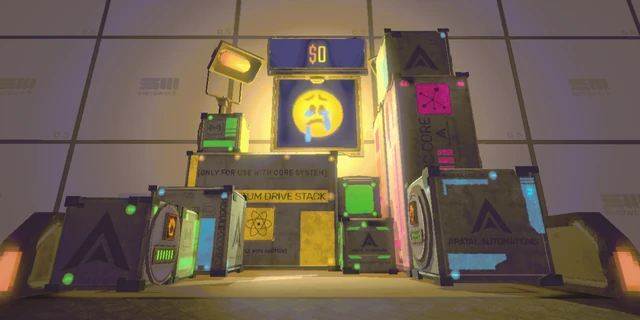
Gear and items · R.E.P.O. v0.4.0 · read from a local copy
The token machine's show
The machine is run by an animator that points back at the machine.
The cosmetic machine in R.E.P.O. stages its handover rather than only dispensing: a token is followed along a curve and inserted, a plate lights up, a grab beam with a spring in the middle carries the item out, the screen spins and settles, and the reward has a different sound for each grade.
What the game establishes
- The machine is run by an animator that points back at the machine. (checked against the game's own files)
- Token objects are listed, and a token follows a curve to a target transform from a parent. (checked against the game's own files)
- The token has a light with a set of colours, and sparkles whose colours are chosen the same way. (checked against the game's own files)
- A plate carries intro and outro emission curves and its own lights, and arrow renderers carry an emission curve. (checked against the game's own files)
- The handover uses a beam with renderers, an origin, a middle on a spring, scale curves in and out, and orbs with particles. (checked against the game's own files)
- The screen spins and has a separate settle transform with its own curve. (checked against the game's own files)
- The machine stages the player with a camera transform, a spin curve, pose curves in and out, player lights and poses, and tumble and camera targets. (checked against the game's own files)
- Its screen has base and currency icons with curves in and out, an impulse transform and curve, and particles for the currency. (checked against the game's own files)
- There are loops for the base idling and shaking, arrow blink sounds and a screen speed-up and stop. (checked against the game's own files)
- The token has a sound for each stage of its journey: spawning, twirling, flying, impacting and being inserted. (checked against the game's own files)
- The plate switches on and off with its own sounds, and the screen has sounds for switching an icon, paying out currency, and a cosmetic's intro, outro and frame. (checked against the game's own files)
- There is a separate reward sound for each grade: common, uncommon, rare and ultra rare. (checked against the game's own files)
- Cannons with firing, intro and outro sounds, and confetti, finish the show. (checked against the game's own files)
In play
The machine that hands out cosmetics is written as a show rather than as a shop. It is run by an animator that points back at the machine, which is why so much of what it does is a sequence with a beginning, a middle and a payoff.
A token is an object, not a number. The machine keeps a list of token objects and a list of the ones already inserted, and a token follows a curve towards a target transform from a parent, so it travels rather than appearing.
The token has a light with its own set of colours, and sparkles whose colours are chosen the same way, so the same token can be lit differently depending on what is happening to it.
A plate is part of the sequence. It has its own intro and outro emission curves and its own lights, which is how the machine can look like it is charging before anything moves.
Arrows carry the eye along. There are arrow renderers with an emission curve, so the machine can indicate direction rather than only flashing.
The handover uses a beam. There are renderers for it, an origin, a middle that sits on a spring, and separate curves for scaling it in and out, with orbs and orb particles at the end, which is why a cosmetic is grabbed out rather than simply appearing in front of you.
The screen is staged as well. It spins and then has a separate settle transform with its own curve, so the display overshoots and comes to rest instead of stopping dead.
The machine also stages the player. It has a camera transform, a spin transform with a curve of its own, pose curves for going in and out, player lights and poses, and targets for the player's tumble and camera, which is why the machine takes over the view rather than playing beside it.
Its screen has an icon for the base and one for the currency, each with curves in and out, an impulse curve for the currency icon and particles for it, so the payout is animated rather than counted.
The whole thing is sounded from end to end. There are loops for the base idling and shaking, a blink for the arrows, speeds for the screen, and a sound for each stage of the token's journey: spawning, twirling, flying, impacting and being inserted.
The plate switches on and off with its own sounds, the screen has sounds for switching an icon and for paying out currency, and it has an intro, an outro and a frame sound for the cosmetic itself.
The reward is voiced by grade. There is a separate sound for a common, an uncommon, a rare and an ultra rare result, which is why two pulls do not sound alike, and cannons with their own firing, intro and outro sounds, along with confetti, finish the show.
What this entry does not tell you: what a spin costs, the odds of each grade, or how many cosmetics exist. We have not verified those numbers, so we do not print them.
Related
 Gear and itemsCosmetics and the token machineThe shop contains a machine that gives out player cosmetics.
 Extraction and the shopThe shop between runsThe game has a shopkeeper and a shop manager for the between-run shop.
Version and sources
A local copy of the game, read only. The grounding for each fact is listed on the technical reference pages; nothing here is estimated. Documented build: 0.4.0.